
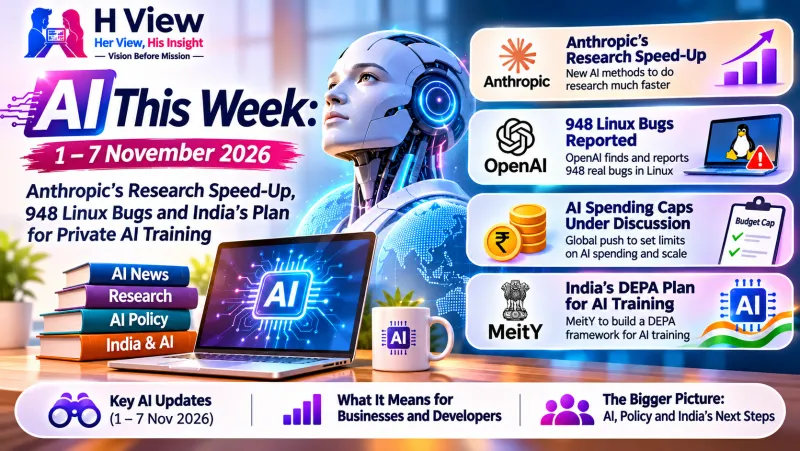
AI This Week: Anthropic's Research Speed-Up, 948 Linux Bugs and India's Plan for Private AI Training
The AI stories from 1 to 7 November 2026 that matter for Indian readers: AI speeding up AI research, an AI system finding hundreds of Linux security bugs, companies capping AI spend, and MeitY's draft plan for training AI without moving personal data.
The biggest AI story of the first week of November 2026 was not a new chatbot. It was evidence that AI is now speeding up the work of building AI, alongside a security result that shows how quickly these systems can find software flaws. Here are the stories that matter most, what they mean for people in India, and what is still unconfirmed.
Is AI now speeding up AI research?
An independent testing group called METR published an assessment on 5 November 2026 after spending 11 weeks, from 12 August to 29 October, observing research work at Anthropic. Its best estimate is that model improvement was running about twice as fast as it otherwise would, with a range of 1.3 to 3 times. METR attributes roughly 80% of that speed-up to Anthropic using its own AI models in research. You can read the method and caveats in METR's report.
Why it matters: if AI tools shorten the time between model generations, the gap between what businesses use today and what is available next year gets smaller. Planning a two-year AI roadmap becomes harder.
What did OpenAI's security agents find in Linux?
OpenAI reported on 4 November that a multi-agent pipeline using a restricted model called GPT-6 Cyber found 948 unique bugs that could let an ordinary user gain full administrator (root) access on Linux. It scanned about 2.8 million lines of code at a cost of about 1.2 million US dollars, according to The Hacker News. The same work found 81 Firefox bugs, which were reported and patched. The model is available only to a vetted security programme.
Why it matters: most Indian business websites and many servers run on Linux. Expect a steady stream of security updates in the coming months. Keeping servers, hosting panels and plugins updated is no longer optional housekeeping.
 Also readAnthropic May Launch a New Claude Model—So Why Is the AI Race Speeding Up Again?→
Which AI coding startups were bought?
- OpenAI is acquiring Pierre Computer, whose open-source tools its Codex coding product already uses.
- Meta acquired Conductor, an app that runs several coding agents at once and supports Claude Code, Codex and Cursor. Conductor stopped new sign-ups on 4 November and says its cloud service closes on 20 November, as reported by SiliconANGLE.
If your team uses Conductor, export anything you need before the shutdown dates.
Why are companies capping AI spending?
Bloomberg reported, as summarised by MacRumors, that Apple is reducing some engineers' daily AI usage budgets from 300 to 200 US dollars. Separately, the UK bank Revolut told The Register it moved about 2,000 engineers from paid coding tools to a self-hosted open model and estimates a cost cut of about 90%. These are the companies' own figures.
Why it matters: the AI bill is becoming a real line item. Small teams should track which AI tools are actually used and whether a cheaper model would do the job.
What is India's DEPA plan for AI training?
On 31 October 2026, the Ministry of Electronics and IT unveiled a draft handbook on DEPA for AI training in Bengaluru. The idea is to train AI models inside secure environments so that personal data, such as hospital or bank records, never leaves the organisation that holds it. It relies on anonymisation, encryption and differential privacy. According to ThePrint, the draft says individual consent is impractical at this scale and leans on governance rules instead. It is open for public comment, with finance and health pilots expected next.
This will be debated. Privacy groups are likely to question the consent position, while hospitals and fintech firms may welcome a clear route to use data safely.
 Also readAre We Digitally Independent? What India Still Depends On in the Age of AI→
Other AI updates worth knowing
- ChatGPT Images 2.6 can now turn a prompt or photo into a looping animated GIF, rolling out gradually.
- Google will switch its AI tools off by default for US school student accounts from early 2027, with schools able to turn them on.
- Moonshot AI released open weights for Kimi K3.1 Pro on Hugging Face, with a licence that requires a separate agreement for large companies.
What should a small business in India do with this?
- Update your website server, CMS and plugins this month, given the volume of security findings.
- List every paid AI tool your team uses and what it costs per month.
- If you handle customer data, follow the DEPA consultation; it may shape how you can use that data with AI later.
If you want help connecting AI tools to your website or business systems without exposing customer data, our API and third-party tool connections service starts with a clear scope and security checks.
Frequently asked questions
Is GPT-6 Cyber available to the public?
No. As reported, it is limited to selected members of a vetted security programme run by OpenAI.
Does the METR report mean AI is improving itself without humans?
No. It estimates that Anthropic's researchers work faster because they use AI tools. Humans still direct the research, and METR gives a wide range of uncertainty.
Can I comment on India's DEPA handbook?
Yes. The draft is open for public comment. Watch MeitY's website for the consultation details and deadline.
Should my business stop using paid AI tools?
Not necessarily. Review usage first. Paid tools may still be worth it for some tasks, while cheaper or open models may cover routine work.
H View stories follow our editorial policy. Spotted an error? Tell us and we will correct it.
Rate this article
One tap is enough. No comment needed.
Was this article helpful?
Your answer goes straight to our editors.











Comments0
No comments yet. Start the conversation.