
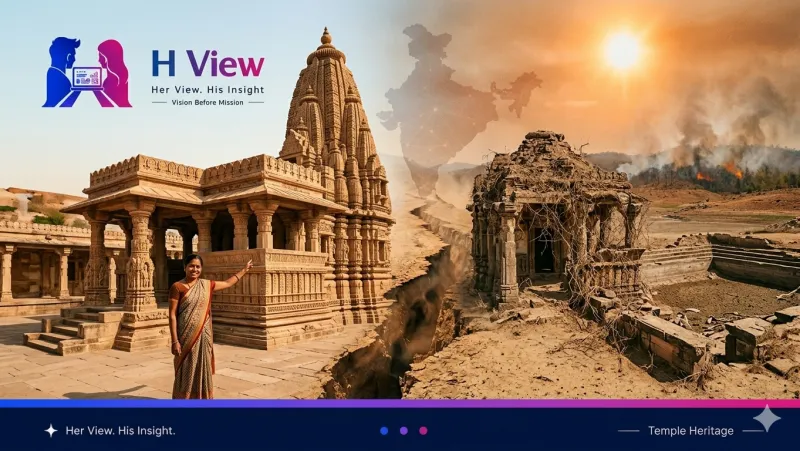
The Stone Sages: Unlocking the Wisdom of Indian Temple Heritage
Indian temples are libraries in stone. How a temple is designed, the Nagara and Dravida styles, the engineering behind Thanjavur and Hampi's musical pillars, and why this heritage needs protecting.
Indian temples are far more than places of worship. They are carefully planned buildings that encode ideas about the cosmos, served as centres of art, learning and local economy, and show remarkable engineering. Sites such as the Chola temples of Thanjavur, the monuments of Hampi and the temples of Pattadakal are recognised by UNESCO as World Heritage for exactly these reasons.
India's skyline was shaped long before skyscrapers, by gopurams and shikharas. From the Himalayas to Kanyakumari, temples dot the landscape. To see them only as religious buildings is to miss their deeper value: they are libraries in stone, records of craft and some of the most sophisticated architecture the world has produced.
At H View, we like to look beyond the surface. Applying our "Vision Before Mission" idea to temple heritage means asking not just what these buildings are, but what they were designed to teach.
How is an Indian temple designed?
A traditional Hindu temple is designed as a path from the busy outer world to a still inner centre. The layout is not random; it follows rules laid down in texts on architecture and sacred geometry, often grouped under the name Vastu Shastra. A typical temple moves through these spaces:
- Gateway: In many southern temples this is a towering, richly carved gopuram that marks the threshold.
- Mandapa: Pillared halls where people gather, music and dance were performed, and rituals prepared.
- Antarala: A small vestibule that connects the hall to the sanctum.
- Garbhagriha: The "womb chamber" or sanctum, usually small, dark and plain, where the main deity resides.
- Shikhara or vimana: The tower rising above the sanctum, pointing the eye upward.
The journey from ornate entrance to bare sanctum is deliberate. It leads the visitor from complexity to simplicity and from noise to stillness. The architecture itself is the method.
What are the main temple architecture styles in India?
Scholars usually describe three broad styles. The Nagara style of the north is known for a curved, beehive-like shikhara over the sanctum. The Dravida style of the south is known for a stepped, pyramid-like vimana and, later, grand gopuram gateways. The Vesara style of the Deccan mixes features of both.
Some sites show these traditions side by side. UNESCO describes the 7th and 8th century Chalukya temples at Pattadakal in Karnataka as achieving "a harmonious blend of architectural forms from northern and southern India."
 Also readWhy Indian Festivals Have Become Major Digital Shopping Events→
Which Indian temples show remarkable engineering?
Several temples continue to impress engineers and musicians alike. Here are well-documented examples:
| Temple | Where | Why it stands out |
|---|---|---|
| Brihadisvara Temple | Thanjavur, Tamil Nadu | Built under the Chola king Rajaraja I and consecrated in his 25th regnal year (1009–1010 CE), according to UNESCO. Part of the "Great Living Chola Temples" World Heritage site. |
| Vijaya Vittala Temple | Hampi, Karnataka | Famous for its musical pillars, which produce musical notes when gently tapped. UNESCO calls the Vitthala temple the most ornate structure at Hampi. |
| Airavatesvara Temple | Darasuram, Tamil Nadu | Another of the Great Living Chola Temples, known for fine sculpture. |
| Pattadakal group | Karnataka | Northern and southern styles side by side on one site. |
The Great Living Chola Temples were inscribed on the World Heritage List in 1987, with the Gangaikondacholapuram and Darasuram temples added in 2004. The Group of Monuments at Hampi, the capital of the Vijayanagara empire between the 14th and 16th centuries, was inscribed in 1986. Classic FM describes the Vittala temple's 56 pillars, each about 3.6 metres tall, that give off delicate notes when tapped; they are now fenced off to protect them from damage.
Why were temples the centre of community life?
Historically, a large temple did much more than host worship:
- Learning: Temple walls carry inscriptions, and carved panels told stories from epics and Puranas to people who could not read.
- Art: Classical dance and music traditions grew in temple spaces, and sculpture records dance poses, instruments and costume in stone.
- Economy: Inscriptions from major temples record land grants, endowments and payments to artisans and staff, which made temples important local employers.
- Gathering: Festivals, fairs and processions brought whole regions together.
What threatens temple heritage today?
Urban encroachment, pollution, unplanned renovation and the theft of idols all put this legacy at risk. The Archaeological Survey of India protects thousands of centrally protected monuments, but preservation cannot be the government's job alone. Visitors can help in simple ways: follow site rules, avoid touching fragile carvings, never buy antiquities of unclear origin and support local guides who share accurate history.
Her View
When I walk through an old temple, what stays with me is how human it feels. Someone measured every step, carved every dancer and chose where the light would fall. These buildings were made to slow us down and help us feel connected. Caring for them is a way of respecting the many hands and generations that built them.
 Also readSend a Diwali Greeting That Lights Up: Make One Free in a Minute→
His Insight
Look at a temple as a project and it becomes even more impressive: long-term planning, standard measurements, skilled teams and a clear user journey from gate to sanctum, all without modern machines. There are real lessons here for designers and planners today, especially in how public spaces can serve faith, art, trade and community at once.
H View Verdict
Indian temple heritage is a living record of art, science and community. The best way to honour it is to learn its real history, separate fact from myth and protect these sites so that their stone continues to teach future generations.
Frequently Asked Questions
What are the main parts of a Hindu temple?
A typical temple has a gateway, one or more pillared halls (mandapas), a vestibule (antarala), the sanctum (garbhagriha) and a tower above the sanctum, called a shikhara in the north and a vimana in the south.
What is the difference between Nagara and Dravida temples?
Nagara temples, common in the north, have a curved, beehive-like shikhara. Dravida temples, common in the south, have a stepped, pyramid-like vimana and often large gopuram gateways.
Which Indian temples are UNESCO World Heritage Sites?
Examples include the Great Living Chola Temples in Tamil Nadu, the Group of Monuments at Hampi and the Group of Monuments at Pattadakal in Karnataka, among others.
Do the Hampi pillars really make music?
Yes. The pillars of the Vijaya Vittala temple produce musical notes when gently tapped. They are now fenced off to prevent damage.
H View stories follow our editorial policy. Spotted an error? Tell us and we will correct it.
Rate this article
One tap is enough. No comment needed.
Was this article helpful?
Your answer goes straight to our editors.












Comments0
No comments yet. Start the conversation.