
SAR Value Explained: What Phone Radiation Ratings Can and Cannot Tell You
Understand what SAR measures, India’s handset limit, why lower ratings do not automatically mean lower everyday exposure, and what health agencies say.
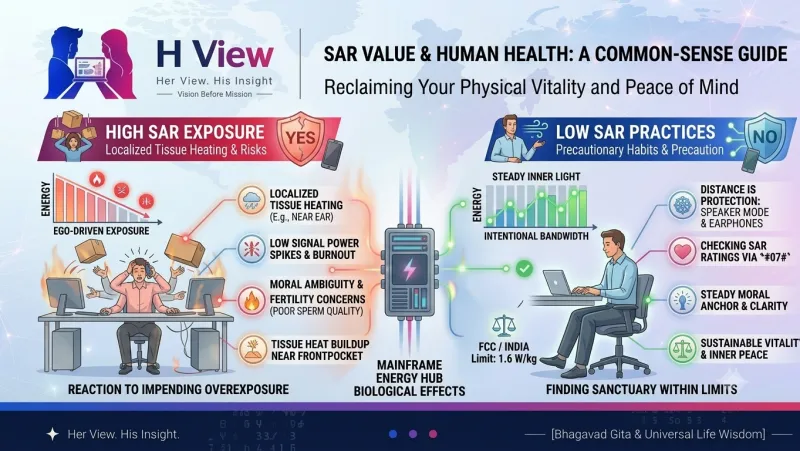
Specific Absorption Rate (SAR) describes the rate at which radiofrequency energy is absorbed by body tissue under specified test conditions. It is a compliance measurement, not a diagnosis or a personal cancer-risk score. Understanding the test conditions matters more than treating one advertised number as a complete verdict on a phone.
A student comparing two phones may find different SAR figures and assume that the smaller number identifies the healthier purchase. A parent may read a frightening message about radiation and wonder whether an everyday call is dangerous. Both deserve an explanation that separates what a measurement means, what health agencies say and what remains uncertain.
What does a SAR value actually measure?
SAR is expressed in watts per kilogram, written as W/kg. The number describes absorbed power per unit mass, rather than the total energy accumulated over someone’s lifetime. A published rating belongs to specified equipment, operating conditions and a measurement method.
The Telecommunication Engineering Centre’s SAR laboratory explains its role in checking mobile-handset compliance. TEC stands for Telecommunication Engineering Centre, and its laboratory audits handset declarations against the applicable requirements. Such laboratory work cannot be reproduced by looking at the signal bars on your screen.
Three questions that should stay separate
A compliance number cannot answer every medical question about an individual.
What is the handset limit in India?
India’s Department of Telecommunications guidance gives a handset SAR limit of 1.6 W/kg averaged over one gram of tissue. The averaging mass is part of the measurement, so it should travel with the number whenever it is explained. A comparison that drops those conditions can mislead even when both numbers were copied correctly.
For example, 1.6 W/kg over one gram and 2 W/kg over ten grams are not interchangeable labels. You cannot conclude that one standard permits a particular percentage more personal harm by dividing the two headline figures. Compliance standards and health outcomes answer different questions.
 Also readWhy Phone Videos Are So Huge: Resolution, Bitrate and Codecs Explained Simply→
Does a lower listed SAR mean lower everyday exposure?
The United States Federal Communications Commission, or FCC, has explained that maximum SAR is not necessarily a reliable indicator of typical exposure. Its 2013 review, paragraph 234, identifies network conditions, operating power, different radios and phone position as reasons comparisons can be confusing. That document is used here to explain a measurement limitation, rather than as a new medical finding.
Imagine that Phone A has a lower advertised maximum than Phone B. Those two labels do not tell you the power used during your actual journey, the connection conditions or how you held either device. Without matching information, declaring A the safer everyday choice goes further than the comparison supports.
Read the label without adding a claim it cannot support
| Information | What it helps establish | What it cannot establish alone |
|---|---|---|
| Published SAR rating | A result reported for specified test conditions. | Your exact exposure during every call. |
| Regulatory compliance | Whether applicable requirements are met. | A guarantee that all health questions are permanently settled. |
| A health-agency evidence summary | How the wider research is assessed. | A diagnosis for your symptoms. |
This is an interpretation guide, not a ranking of specific phones.
Is phone radiation the same as an X-ray?
Phones communicate using radiofrequency energy, abbreviated to RF. The National Cancer Institute’s evidence summary places this in the non-ionizing part of the electromagnetic spectrum. It distinguishes that energy from ionizing radiation, including X-rays, which can damage DNA.
Non-ionizing does not mean that every exposure at every possible power is harmless. The same agency identifies heating as the consistently recognized biological effect of RF absorption relevant to this discussion. Neither that fact nor a warm phone gives you a way to calculate a medical outcome from touch.
What do health agencies currently say?
The United States Food and Drug Administration, or FDA, says the weight of scientific evidence has not linked cell-phone RF radiation with health problems. It also says it continues monitoring studies and public-health information. This is an assessment of the available evidence, not a promise about every possible future finding.
The Centers for Disease Control and Prevention, or CDC, uses more cautious wording about unresolved long-term questions and continuing research. Readers should see that uncertainty rather than a claim that all questions have been settled. Equally, uncertainty does not establish that an individual phone has caused a particular illness.
What can you check without buying another phone?
Begin with the manufacturer’s documentation for your exact model and market. Look for the reported rating, the relevant test description and the device’s usage instructions. A screenshot for a similarly named model sold elsewhere may not describe the handset in your hand.
- Use speakerphone or a suitable hands-free arrangement when you want more distance during calls.
- Keep the phone’s actual model information with any SAR figure you save.
- Check medical-device guidance separately if you use an implanted device.
- Discuss persistent symptoms with a healthcare professional rather than diagnosing them from a phone specification.
The CDC includes speakerphone and a directly connected headset among ways to reduce RF exposure near the body. These are options for concerned users, not treatments for a disease. Follow the instructions for your phone and any medical device instead of relying on a universal distance claim from social media.
How should SAR fit into a buying decision?
Check compliance and reliable documentation before making a health comparison. Then evaluate the features you actually need, such as software support, repair options and comfortable daily use. Our guides to budget-phone compromises, camera features and battery capacity versus battery life explain other decisions without turning one specification into an overall verdict.
Her View
Health concerns deserve respectful explanations rather than frightening headlines. A family should be able to understand a specification without being told that a laboratory number predicts their future illness. Clear sourcing and honest limits make this discussion more useful.
 Also readHow Git Thinks: Working Folder, Staging Area and Repository Explained (Part 4)→
His Insight
The important technical habit is checking what was measured before comparing results. A number without its method can sound precise while answering the wrong question. The same habit helps students evaluate battery claims, camera scores and many other specifications.
H View Verdict
Use SAR as one part of understanding regulatory compliance. Do not convert a lower listed maximum into a personal-health guarantee, and do not treat an alarming anecdote as proof of causation. Where your circumstances require medical advice, a consumer-technology article cannot replace it.
FAQs
What is SAR in simple language?
It is the rate at which body tissue absorbs RF energy under specified conditions. The unit is watts per kilogram. The rating is not a personal disease-risk score.
What SAR limit applies to handsets in India?
Department of Telecommunications guidance gives 1.6 W/kg averaged over one gram of tissue. The averaging mass matters when reading the figure. Check the documentation for your exact handset rather than a different regional model.
Should I buy the phone with the lowest SAR?
The listed maximum alone cannot establish the lowest exposure in everyday use. Conditions and measurement details also matter. Treat compliance documentation as a starting point rather than a complete health ranking.
Does a compliant SAR prove there is zero health risk?
Compliance and a zero-risk guarantee are different claims. Health agencies assess broader research and continue monitoring evidence. A rating should not be used to diagnose or dismiss someone’s symptoms.
Does H View test handset radiation?
No laboratory radiation measurements were carried out for this article. This is a desk-researched explanation of regulator and health-agency guidance. It does not provide a medical diagnosis or claim specialist clinical review.
Research method and update note
This article was revised on 29 October 2026 using the linked TEC, Department of Telecommunications, FCC, National Cancer Institute, FDA and CDC material. The hypothetical two-phone comparison explains a measurement limitation and is not a test result. Unsupported statements about fertility, sleep effects and precise temperature changes in the earlier version were removed because this article did not establish evidence for them.
H View stories follow our editorial policy. Spotted an error? Tell us and we will correct it.
Rate this article
One tap is enough. No comment needed.
Was this article helpful?
Your answer goes straight to our editors.









Comments0
No comments yet. Start the conversation.