
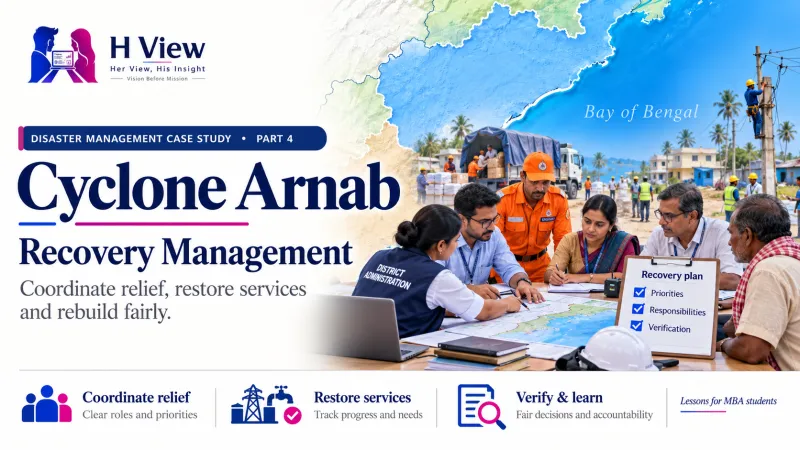
Cyclone Arnab Case Study: Recovery Management (Part 4)
A case study on managing Cyclone Arnab recovery: how to prioritise relief, restore services, verify losses and measure results.
Case snapshot · Evidence cutoff: 29 October 2026, 5:55 p.m. IST
Cyclone Arnab is examined here as a management case. The India Meteorological Department reported that the system weakened into a depression over south Chhattisgarh and adjoining south Odisha by 5:30 a.m. IST on 29 October. This case examines the shift from cyclone response to recovery management. IMD bulletin, 29 October The storm has crossed the coast and weakened; the management challenge has shifted to protecting people, restoring essential services, verifying losses and planning recovery. All figures below are preliminary and time-stamped. They are not a final audit or a live safety advisory.
The major strategy
With incomplete information, limited crews and a large recovery bill, a state team needs a clear strategy for sequencing relief, restoration and compensation. The management challenge is to act quickly while keeping decisions fair, evidence-based and open to correction.
1. Actual scenario
Preparedness decisions began before landfall. On 26 October, the National Crisis Management Committee reported that shelters and evacuation arrangements were in place, district control rooms were active, and NDRF and SDRF teams were on standby. The forecast then pointed to a very severe storm crossing the Andhra Pradesh–Yanam coast. Those were planning assumptions, not guarantees about the exact local impact. PIB: NCMC preparedness review, 26 October
By the evening of 29 October, public reporting described deaths, crop loss and damaged infrastructure, while field verification and central assessment were still under way. A Chief Minister’s preliminary statewide damage estimate was reported at about ₹4,600 crore and explicitly could rise after detailed assessment. The management learning is to act on urgent needs while keeping estimates open to correction. NDTV report, 29 October, 5:55 p.m. IST
Crop figures were reported from the State Agriculture Minister’s preliminary assessment: 2,24,489 hectares across 14 districts, affecting an estimated 3.45 lakh farmers. The estimate is not a verified beneficiary list. The Pioneer, 29 October
 Also readCyclone Arnab Case Study: Damage, Relief and Recovery (Part 3)→
2. Recovery management strategy
This strategy map helps readers check that recovery is not reduced to one department or one headline number.
Safety checks · shelters · food · drinking water · health · accessible grievance help
Power · roads · telecom · water · sanitation · hospitals and schools
Crop surveys · livestock and fisheries · market access · insurance support
Damage evidence · eligibility · approvals · payment tracking · audit trail
After-action review · stronger assets · updated plans · public lessons
3. Priority table across departments
A useful management tool is a single, shared queue. It makes trade-offs visible and reduces the risk that the loudest request automatically receives the first crew.
| Priority | Decision test | Example action | Proof to record |
|---|---|---|---|
| 1 · Life safety | Is there immediate danger or a person needing urgent help? | Rescue, medical referral, safe shelter, hazard isolation | Location, time, team, people assisted, unresolved risk |
| 2 · Essential service | How many people depend on it, and does it unlock another service? | Restore water, hospital power, access road or telecom link | Population served, safety check, expected update |
| 3 · Livelihood | Which losses threaten food, income or the next planting cycle? | Survey farms, clear market routes, explain insurance and relief | Survey method, affected area, claimant status |
| 4 · Rebuild better | Can repair reduce repeat failure without delaying urgent aid? | Use resilient standards for permanent repairs | Design choice, cost, approval and risk reduced |
4. Keeping the situation honest
Every important figure needs a timestamp, scope and status. That lets managers act quickly without turning an early estimate into a false promise.
| Item | What was reported | Status and management use |
|---|---|---|
| Deaths | 7 reported in the 29 Oct, 5:55 p.m. update | Reported count; confirm through official district records and maintain family support. |
| Statewide damage | About ₹4,600 crore preliminary estimate | Not a sanctioned budget or final loss; refine by department and asset. |
| Crop impact | 2,24,489 ha across 14 districts; about 3.45 lakh farmers in preliminary report | Survey estimate; verify plot, crop stage, overlap and eligibility before payment. |
| Power restoration | About 8,000 poles reported fallen in Konaseema; additional crews sought | A repair workload signal; track safe connections restored and villages still without service. |
Sources: NDTV, 29 October 2026; The Pioneer, 29 October 2026. Figures have different scopes and reporting methods; do not add them together.
5. Separate damage, need, budget and payment
A damage estimate answers “what may have been damaged?” It does not automatically answer “what does each family need?”, “what funds are approved?” or “what has been paid?”. Managers should track those as separate stages.
Inspect and record loss
Identify urgent support
Confirm rule and funding
Track receipt and appeal
For example, the reported ₹4,600 crore is a preliminary total-loss estimate. It should not be described as money already available to spend. Crop relief announcements, central assistance, insurance claims and permanent infrastructure repair may follow different rules and timelines. A transparent dashboard should show amount requested, amount approved, amount released, amount paid, number of beneficiaries and unresolved claims—each with an “as of” date.
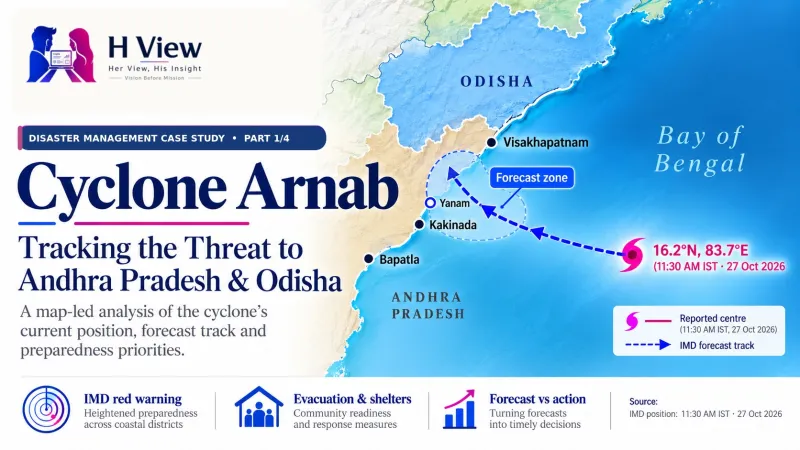 Also readCyclone Arnab Case Study: Before Landfall (Part 1)→
6. Measure outcomes, not only activity
| Activity count | Outcome question | What a manager should review |
|---|---|---|
| Teams dispatched | Were urgent calls reached safely and quickly? | Response time, missed locations, safety incidents |
| Poles repaired | Are homes and critical facilities receiving safe, reliable power? | Service restored, repeat faults, remaining outages |
| Damage forms completed | Did eligible households receive the right assistance? | Payment time, exclusions, appeals and corrections |
| Roads cleared | Can residents reach health care, markets and relief? | Access restored, vulnerable areas reached, permanent repair needs |
Also read: Cyclone Arnab Case Study: Before Landfall (Part 1).
7. Management path
First, coordinate through one operating picture. Departments need a shared list of affected places, requests, assigned teams, risks and next updates. A common picture reduces duplicate work and exposes gaps.
Second, decide transparently under uncertainty. Record what was known, who decided, why that option was chosen and when it will be reviewed. This protects both speed and accountability.
Third, distinguish relief from recovery. Food, safe water and urgent repairs cannot wait for a complete audit; final compensation and permanent reconstruction require clear evidence and rules. Run both tracks together, with different controls.
Fourth, treat communication as an operational service. Tell residents what is open, what is unsafe, when the next update will arrive and how to correct a missing or inaccurate claim. Use local languages and accessible channels.
Finally, learn without blame. After the immediate response, compare forecast, decisions, service restoration and outcomes. Find which systems failed, which worked and what should change before the next hazard. The Sendai Framework calls for understanding risk, strengthening risk governance, investing in resilience and improving preparedness to “Build Back Better.” UNDRR: Sendai Framework
FAQs
Is ₹4,600 crore the final cyclone loss or approved relief budget?
No. It was reported as a preliminary statewide damage estimate on 29 October 2026, and the figure could change after detailed assessment. A damage estimate is not the same as approved funds or payments made.
Why should relief begin before every loss is verified?
People may need food, water, shelter, medical care and safe access immediately. Managers can provide urgent support under clear rules while verifying detailed claims separately for targeted compensation.
How can officials make compensation fair?
Publish eligibility and evidence rules, provide accessible ways to apply, record decisions, explain rejections and offer an appeal or correction channel. Check who may be missed by digital-only processes.
What is the difference between output and outcome?
An output is work completed, such as poles repaired. An outcome is the change for people, such as safe power restored to homes and essential services. Both matter, but outcomes show whether the work solved the problem.
What should be reviewed after the recovery phase?
Review warning reach, evacuation access, coordination, service interruptions, relief fairness, fund tracking and infrastructure resilience. Convert findings into named actions, owners and deadlines for the next season.
Sources and case note
- Press Information Bureau: National Crisis Management Committee preparedness review, 26 October 2026
- India Meteorological Department: Arnab weakened into a depression, 29 October 2026
- Press Information Bureau: Union Home Minister’s assistance and response update, 29 October 2026
- NDTV: preliminary damage and recovery measures, 29 October 2026, 5:55 p.m. IST
- The Pioneer: preliminary crop assessment, 29 October 2026
- UNDRR: Sendai Framework for Disaster Risk Reduction
Educational case study, based on public reporting available up to 29 October 2026, 5:55 p.m. IST. Preliminary figures may be revised. This article is not a live warning or an official relief eligibility notice. Follow IMD bulletins and district administration instructions for current safety information.
H View stories follow our editorial policy. Spotted an error? Tell us and we will correct it.
Rate this article
One tap is enough. No comment needed.
Was this article helpful?
Your answer goes straight to our editors.










Comments0
No comments yet. Start the conversation.