
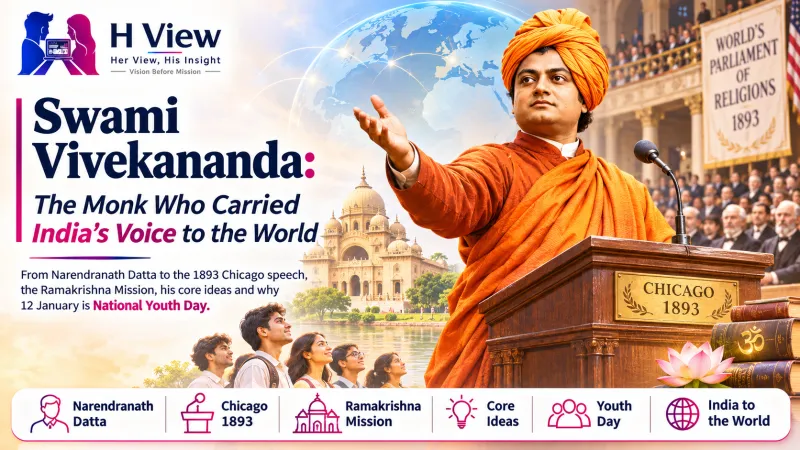
Swami Vivekananda: The Monk Who Carried India’s Voice to the World
He died at 39, but in less than a decade he changed how the world saw India and how India saw itself. The story of Swami Vivekananda.
Swami Vivekananda (1863–1902) was a Bengali monk, disciple of Sri Ramakrishna, who introduced Vedanta and yoga to the West with his famous address at the Parliament of the World’s Religions in Chicago on 11 September 1893. He founded the Ramakrishna Mission in 1897, and India marks his birthday, 12 January, as National Youth Day.
At a glance
| Birth name | Narendranath Datta |
| Born | 12 January 1863, Calcutta (Kolkata) |
| Guru | Sri Ramakrishna Paramahamsa (first met 1881) |
| Defining moment | Chicago address, 11 September 1893 |
| Founded | Ramakrishna Mission, 1 May 1897; Belur Math |
| Died | 4 July 1902, Belur Math, aged 39 |
Who was Swami Vivekananda?
He was a sharp, restless young man from an educated Kolkata family who wanted proof, not promises, about God. He studied Western philosophy at Scottish Church College, joined reform debates of the Brahmo Samaj, and asked holy men the same blunt question: have you seen God? Only one, an unlettered priest at the Dakshineswar Kali temple, answered yes. That meeting with Sri Ramakrishna set the course of his life.
How did Ramakrishna shape him?
Narendra argued with Ramakrishna for years, tested him and doubted him. Ramakrishna, for his part, treated him with unusual affection and patience, convinced the young man had a mission. After Ramakrishna’s death in 1886, Narendra and a few fellow disciples took monastic vows at Baranagar, living in poverty in a crumbling house.
The deeper lesson he carried was Ramakrishna’s insistence on shiva jnane jiva seva: serve people as God. It became the backbone of the Ramakrishna Mission.
 Also readSri Ramakrishna Paramahamsa: The Priest of Dakshineswar Who Tested Every Path to God→
What did he see while wandering India?
From 1888 to 1893, he travelled the country on foot and by train as a wandering monk, from the Himalayas to the south, staying with princes and the poor alike. He saw poverty and caste humiliation up close. In December 1892, he swam to a rock off Kanyakumari and meditated there for three days; he later described resolving there to work for India’s masses. That rock now holds the Vivekananda Rock Memorial.
What happened at Chicago in 1893?
Supported by friends including the Raja of Khetri, who suggested the name “Vivekananda”, he sailed to America. At the opening of the Parliament of the World’s Religions on 11 September 1893, he began with “Sisters and Brothers of America”, and the audience rose in a long ovation. His short speech argued that all religions are paths to the same truth and condemned sectarianism and fanaticism. Over the next years he lectured across the US and Britain and founded the Vedanta Society of New York in 1894.
1863 — Born in Kolkata.
1881 — Meets Sri Ramakrishna at Dakshineswar.
1886 — Ramakrishna dies; monastic life begins at Baranagar.
1888–1893 — Travels India as a wandering monk; Kanyakumari, December 1892.
1893 — Chicago address, 11 September.
1897 — Returns to India; founds the Ramakrishna Mission on 1 May.
1899 — Belur Math formally consecrated as the order’s headquarters.
1902 — Dies at Belur Math on 4 July.
What were his core ideas?
| Idea | In his terms | What it means today |
|---|---|---|
| Divinity of every person | Each soul is potentially divine | Respect and self-belief |
| Service as worship | Serve people as God | Social work as spiritual practice |
| Four yogas | Karma, Bhakti, Raja and Jnana Yoga | Choose a path that fits your temperament |
| Strength | Strength is life, weakness is death | Courage, fitness and confidence |
| Harmony of religions | Acceptance, not just tolerance | Interfaith respect |
Why is 12 January National Youth Day?
In 1984, the Government of India declared his birthday National Youth Day, observed from 1985, because his message of self-confidence, character and service speaks especially to young people. Schools and colleges across the country mark it with talks and service activities.
 Also readRamana Maharshi: The Silent Sage of Arunachala and the Question “Who Am I?”→
Where can you trace his life today?
- Belur Math, Howrah — headquarters of the order and site of his samadhi temple.
- Swami Vivekananda’s Ancestral House, Kolkata — his birthplace, now a museum.
- Dakshineswar Kali Temple — where he met Ramakrishna.
- Vivekananda Rock Memorial, Kanyakumari — reached by ferry.
Her View: His message is often reduced to motivational quotes, but the real Vivekananda was tender too: a man who wept over hunger and insisted that serving the poor was worship.
His Insight: He built a global institution in under nine years, with no money and no network. That is a lesson in clarity of purpose for any founder.
Frequently asked questions
What did Swami Vivekananda say in Chicago?
He opened with “Sisters and Brothers of America” and spoke of India’s tradition of accepting all religions as true, calling for an end to sectarianism and fanaticism.
When did Swami Vivekananda die?
He died at Belur Math on 4 July 1902, aged 39.
What is the Ramakrishna Mission?
A spiritual and service organisation he founded on 1 May 1897, running schools, hospitals and relief work alongside the Ramakrishna Math monastic order.
Why is National Youth Day celebrated?
To honour Vivekananda’s birthday, 12 January, and his message to young people. It has been observed since 1985.
Sources and how this article was researched
This is a desk-research article based on the sources below.
- Ramakrishna Math and Ramakrishna Mission, Belur Math (official website)
- Wikipedia: Swami Vivekananda
- The Complete Works of Swami Vivekananda, Advaita Ashrama
Part of H View’s Devotion & Heritage series. Previously: Ramana Maharshi. Next: Sri Ramakrishna Paramahamsa.
H View stories follow our editorial policy. Spotted an error? Tell us and we will correct it.
Rate this article
One tap is enough. No comment needed.
Was this article helpful?
Your answer goes straight to our editors.







Comments0
No comments yet. Start the conversation.