
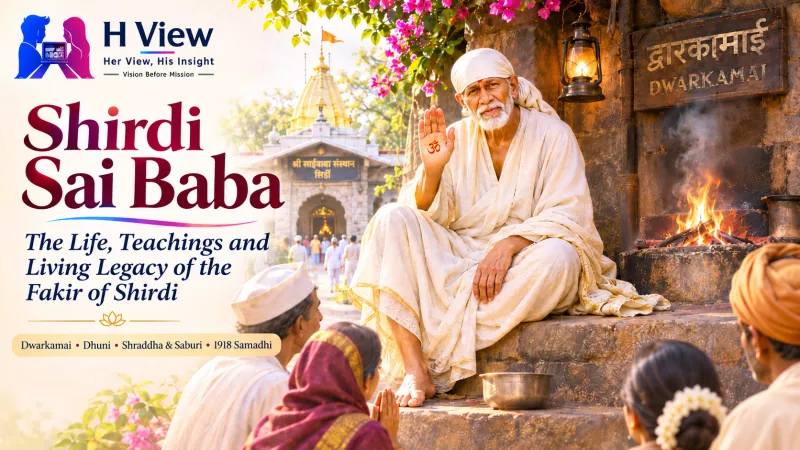
Shirdi Sai Baba: The Life, Teachings and Living Legacy of the Fakir of Shirdi
A fakir arrived in a small Maharashtra village in the 1850s and never really left. This is the story of Shirdi Sai Baba, what he taught, and why millions still walk to his samadhi.
Shirdi Sai Baba, revered in the Datta Sampradaya as an Avadhuta of the Dattatreya tradition, was a saint and fakir who lived for about sixty years in the village of Shirdi in Maharashtra and died there on 15 October 1918, on Vijayadashami. Revered by Hindus and Muslims alike, he taught faith (Shraddha) and patience (Saburi), and his samadhi now draws tens of thousands of visitors every day.
At a glance
| Known as | Sai Baba of Shirdi; “Sai” is often read as a Persian word for saint |
| Birth | Unknown; he never gave a clear account of his birthplace, parents or faith |
| Arrived in Shirdi | Around 1858 (an earlier short stay as a youth is described in devotional accounts) |
| Home | Dwarkamai, an old mosque, where he kept a sacred fire (dhuni) |
| Core teaching | Shraddha (faith) and Saburi (patient perseverance); “Sabka Malik Ek” |
| Samadhi | 15 October 1918, Vijayadashami; buried in Buti Wada, now the Samadhi Mandir |
| Main text | Shri Sai Satcharitra by Govind R. Dabholkar (“Hemadpant”), in Marathi |
Who was Shirdi Sai Baba?
He was a wandering ascetic who settled in a dusty village in Ahmednagar district and became, almost without trying, one of the most loved spiritual figures in modern India. What makes him unusual is how little he claimed. He did not found a sect, write a book or set rules for followers. He begged for food, tended a fire, spoke in short and often puzzling sentences, and treated whoever came to him as if they belonged there.
Even his origins are a deliberate blank. Asked who he was, he gave answers that pointed nowhere in particular. He dressed like a Muslim fakir, lived in a mosque and was heard saying “Allah Malik”, yet he kept a dhuni, allowed Hindu worship around him and let devotees call the mosque Dwarkamai, after Krishna’s city. Followers of both faiths found in him exactly what they needed, and he seems to have wanted it that way.
How did a wandering fakir end up in Shirdi?
Devotional accounts describe a young ascetic seen under a neem tree in Shirdi before he left and later returned with Chand Patil’s wedding party, often dated to around 1858. Near the Khandoba temple, the priest Mhalsapati greeted him with “Aavo Sai”, meaning “Come, Sai” or “Welcome, Sai.” Others took up the name, and the ascetic became known as Sai Baba.
In the Datta Sampradaya, devotees honour Sai Baba as a Datta Avadhuta, a realised renunciant whose life was free of ordinary attachments and social distinctions. The Shirdi Sansthan’s Shri Sai Leela records an aarti that addresses him as both Datta Avadhuta and Sai Avadhuta. That devotional understanding helps explain why his simple belongings and daily acts of service matter so much to followers.
A timeline of his life in Shirdi
c. 1858 — Settles in Shirdi; named “Sai” by Mhalsapati.
1858–1900s — Lives in Dwarkamai; keeps the dhuni burning; goes on bhikshatana and shares what he receives.
Early 1900s — Visitors from Mumbai and Pune increase; regular worship begins around him.
1910s — Govind Dabholkar begins recording incidents that become the Shri Sai Satcharitra.
15 October 1918 — Dies on Vijayadashami; body laid in Buti Wada, built by devotee Gopalrao Buti.
1922 — Shri Saibaba Sansthan formed under an order of the Ahmednagar District Court to manage the shrine.
 Also read10 Temples in India Everyone Should Visit at Least Once→
The satka, the jholi and the cooking pot
Baba wore a long robe called a kafni and carried a short stick known as a satka. When he went on bhikshatana, the renunciant’s practice of asking households for alms, he carried a cloth bag or jholi for bread and other solid food and a small tin vessel called a tumrel for liquids. Chapter 8 of the Shri Sai Satcharitra describes how what he brought back was shared, even with animals and birds.
Baba also cooked for devotees and people in need. Chapter 38 describes him preparing meals in a large handi at Dwarkamai, attending to the ingredients himself and arranging for the food to be distributed. The alms round and the cooking pot show two sides of his relationship with Shirdi: households fed him, and he in turn made sure others were fed.
How did Sai Baba light diyas with water?
Chapter 5 of the Shri Sai Satcharitra recounts that shopkeepers who usually supplied oil refused it one evening. Baba placed dry wicks in the lamps, added water to his tin vessel, then filled and lit the diyas. In the devotional account, the lamps burned through the night. When the shopkeepers apologised, Baba forgave them and asked them to be truthful. The story is remembered for that response as much as for the miracle.
What did Sai Baba actually teach?
His teaching was practical rather than philosophical. Two words sum up most of it: Shraddha, steady faith, and Saburi, patience that does not give up. He told people to trust, wait and keep doing what was right, rather than chase quick miracles.
- One God behind many names. The phrase “Sabka Malik Ek” (one master of all) is the line most closely linked with him.
- Feed people. He cooked in a large pot at Dwarkamai and shared the food with anyone who came, regardless of caste or religion.
- Dakshina as a lesson, not a fee. He sometimes asked visitors for money and then gave it away the same day, which devotees read as teaching detachment.
- Udi, the sacred ash. Ash from the dhuni was given to visitors and is still distributed in Shirdi as a sign of blessing.
How did Sai Baba bring people together?
Sai Baba lived at a time when differences of religion, caste and creed often determined whom people worshipped with, ate with or welcomed into their homes. At Dwarkamai he made room for people from different backgrounds. He used the words “Allah Malik,” kept the sacred dhuni burning in the mosque, and welcomed devotees who approached him through their own forms of worship.
The Shirdi tradition remembers Ram Navami celebrations alongside the Urs fair and sandal procession. People could take part without giving up the traditions they came from. The shared meal made the same point in a more everyday way: a person arriving hungry had a place there, whatever their religion or social standing.
Who were Sai Baba’s early devotees in Shirdi?
The Satcharitra records many people around Baba. Some were Shirdi neighbours who knew him before pilgrims came in large numbers; others arrived from farther away and became part of daily life around Dwarkamai. Here are some of the best documented, and what each is remembered for.
- Mhalsapati, the Khandoba temple priest, is remembered for welcoming Baba and for the nights he and Tatya spent with him at the mosque.
- Bayajabai and Tatya Kote Patil were mother and son. Bayajabai sought Baba out to bring him food in his early years. Tatya became one of his closest companions in Shirdi.
- Madhavrao Deshpande (Shama) was a close attendant who spoke with Baba freely and often helped visitors approach him.
- Lakshmibai Shinde served Baba food and received his final gift of nine rupees. Bhagoji Shinde is remembered for attending to Baba’s hand and carrying the umbrella over him in procession.
- Nanasaheb Nimonkar took part in village worship and contributed a flag to the festival. He was a different devotee from Nanasaheb Chandorkar, the official remembered for discussing scripture with Baba.
- Gopalrao Buti built the wada that became the Samadhi Mandir. Kakasaheb Dixit became a close disciple and built Dixit Wada, where visiting devotees could stay.
- Radhakrishnamai helped organise worship and festival preparations and cared for the spaces Baba used. Abdul Baba, a Muslim disciple, served him closely and preserved notes of his teachings.
- Das Ganu carried Baba’s story to wider audiences through kirtan and writing. Govind Raghunath Dabholkar (Hemadpant) recorded the accounts that became the Shri Sai Satcharitra.

What happened on 15 October 1918?
Sai Baba died at Shirdi on Vijayadashami, 15 October 1918. His body was placed in Buti Wada, a stone building that devotee Gopalrao Buti of Nagpur had been constructing, originally intended for an image of Krishna. That building is today the Samadhi Mandir, the heart of the Shirdi temple complex. Devotees speak of his death as his mahasamadhi, and Vijayadashami remains the most important day in the Shirdi calendar.
Why did Sai Baba give Lakshmibai Shinde nine coins?
In Chapter 42, Hemadpant recalls that Lakshmibai once brought Baba bread after he said he was hungry. He gave it to a dog. When she asked why, he explained that feeding a hungry animal was also a way of feeding him. Her years of bringing food give the final gift its context: just before his mahasamadhi on Vijayadashami in 1918, Baba gave her five rupees first and then four more, nine rupees in all, remembered as the nine coins.
Hemadpant connects the total to Navavidha Bhakti, the nine forms of devotion discussed in Chapter 21: shravan (listening), kirtan (singing or recounting praise), smaran (remembering), padasevan (service at the feet), archan (worship), vandan (bowing in reverence), dasya (serving), sakhya (friendship) and atmanivedan (self-surrender). The chapter also considers a Vijayadashami offering and the qualities of a disciple as possible readings. The text records the gift and its sequence; it does not record Baba assigning a meaning to each individual coin.
 Also readGolden Temple, Amritsar: The Story of Harmandir Sahib and Its Langar→
How does the Shirdi shrine work today?
The shrine is run by the Shri Saibaba Sansthan Trust. According to the trust’s official website, about 25,000 devotees visit daily, rising above one lakh in the festival season. Its Prasadalaya serves free meals to tens of thousands of people a day, continuing the practice of feeding everyone that began in Sai Baba’s own kitchen.
| Place in Shirdi | What it is | Why visit |
|---|---|---|
| Samadhi Mandir | Former Buti Wada; holds his tomb and marble idol | Main darshan and the four daily aartis |
| Dwarkamai | The mosque where he lived | The dhuni still burns; his grinding stone and seat are kept here |
| Chavadi | Village building where he slept on alternate nights | The Thursday palkhi procession links it to Dwarkamai |
| Gurusthan | The neem tree where he first sat as a youth | A quiet spot devotees associate with his arrival |
| Lendi Baug | Garden he watered and walked in daily | Shows the everyday rhythm of his life |
Planning a visit: a simple sequence
- Book darshan or aarti passes on the Sansthan’s official website in advance, especially for weekends and Thursdays.
- Start early with the Kakad (dawn) aarti if you want the calmest experience.
- Visit Dwarkamai and the Chavadi after the Samadhi Mandir; they sit a short walk apart.
- Eat at the Prasadalaya. It is part of the tradition, not just a canteen.
- Avoid unofficial agents offering “VIP” darshan; use only the trust’s counters and site.
Her View: What stays with you in Shirdi is not grandeur but ordinariness: a grinding stone, a cooking pot, a fire. It is a saint’s life measured in daily chores and shared meals.
His Insight: Sai Baba left no organisation and no doctrine, yet the institution built after him feeds tens of thousands a day. Few founders achieve that by design; he did it by example.
How should we read the miracle stories?
The Shri Sai Satcharitra is full of accounts of healing, protection and foreknowledge, and for devotees they are central. A respectful reading holds two things at once: these stories are sincerely recorded by people who knew him, and they are devotional literature rather than historical evidence. You do not need to settle that question to appreciate what the stories consistently show: a man who was patient with people, generous with food and unwilling to divide anyone by religion.
Frequently asked questions
When did Shirdi Sai Baba die?
He died at Shirdi on 15 October 1918, which fell on Vijayadashami. Devotees mark the day as his mahasamadhi.
Was Sai Baba Hindu or Muslim?
No one knows for certain. He lived in a mosque and used Islamic expressions, but also kept a dhuni and allowed Hindu worship. He deliberately avoided being identified with one faith.
What do Shraddha and Saburi mean?
Shraddha means faith and Saburi means patience or perseverance. Sai Baba asked devotees for these two things above all.
What is the Shri Sai Satcharitra?
It is the main devotional biography of Sai Baba, written in Marathi by Govind R. Dabholkar, known as Hemadpant. An English translation by N. V. Gunaji is widely read.
Who manages the Shirdi temple?
The Shri Saibaba Sansthan Trust, which traces its origin to a 1922 order of the Ahmednagar District Court.
Sources and how this article was researched
This is a desk-research article based on the sources below. Devotional accounts are identified as such.
- Shri Saibaba Sansthan Trust, Shirdi (official website)
- Shri Sai Satcharitra, English translation by N. V. Gunaji
- Encyclopaedia Britannica: Sai Baba of Shirdi
Part of H View’s Devotion & Heritage series on India’s spiritual personalities. Next: Ramana Maharshi.
H View stories follow our editorial policy. Spotted an error? Tell us and we will correct it.
Rate this article
One tap is enough. No comment needed.
Was this article helpful?
Your answer goes straight to our editors.













Comments0
No comments yet. Start the conversation.